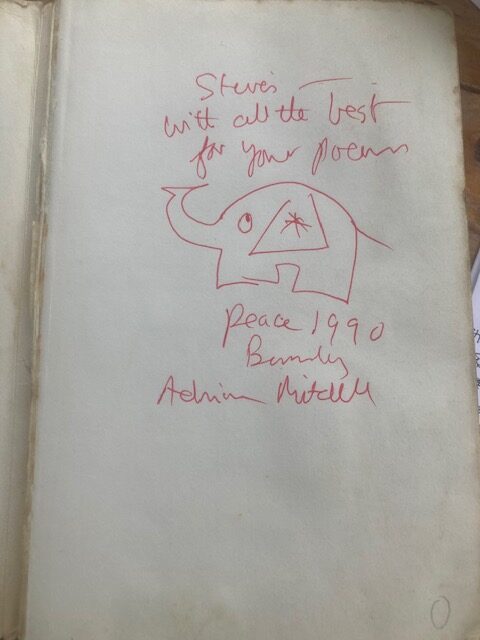
Many years ago, when I was at Uni, a mate gave me a book he no longer wanted. It was the collected poems of Adrian Mitchell, and it had a profound effect on my understanding of what poetry could be and do. Did I like everything in it? No. Was I amazed by its scope and range and powerful humanity? Absolutely. It’s far and away the best second-hand gift I’ve ever been lucky enough to receive.
The book – battered and worn, its covers just about hanging on – still sits in my bookshelves. Last night I pulled it out and searched for a piece of writing within it which made a huge impression on me when I first read it. It’s a piece which resonates more than ever today, when the world seems to be led by governments which revel in war and in state-sanctioned murder. I couldn’t find it online, so I’ve typed out the second half of the piece here. In these dark times, I think it’s something worth sharing.
note: I’ve taken the liberty of making one small change throughout the text, which is to change he/him to they/them. This reflects the fact that the victims of war – as we’ve seen in Gaza and are now seeing in Lebanon and Iran – are often women and children, either deliberately targeted, or considered acceptable ‘collateral damage’ by the soldiers who kill them.
Here’s the piece. Feel free to share it.
“…I would like to see every government in the world held accountable to the United Nations for every human being it kills, either in war or in peace. I don’t just mean a statistic published in a secret report. I mean that all the newspapers of the country responsible should carry the name of the person killed, their photograph, address, number of their dependants and the reason why they were killed. (We often do as much for the victims of plane crashes.)
This would mean that in some countries the press would be swamped with death reports and even mammoth death supplements. (Well, what about the advertisers?) But I want more.
I would like every death inflicted by any government to be the subject of a book published at the state’s expense. Each book would give an exhaustive biography of the corpse and would be illustrated by photographs from their family album if any, pictures they painted as a child and film stills of their last hours. In the back cover would be a long-playing disc of the victim talking to their friends, talking to their family and children and inteviewed by the men who killed them.
The text would examine their life, their tastes and interests, faults and virtues, without trying to make them any more villainous or heroic then they were. It would be prepared by a team of writers appointed by the United Nations. The final chapter would record the explanations of the government which killed them and a detailed account of the manner of their death, the amount of bleeding, the extent of burns, the decibel count of screams, the amount of time it took to die and the names of the men who killed them.
One book for every killing. I realise that this would take some planning. Each soldier would have to be accompanied by an interviewing, camera, and research team in order to record the details of any necessary victim.
Most factories would turn out printing presses, most graduates would automatically become biographers of the dead. Bombing could only take place after individual examination of every person to be bombed. The cost of killing would be raised to such a pitch that the smallest war would lead to bankruptcy and only the most merciful revolution could be afforded. Hit squarely in the exchequer – the only place where they feel emotion – chauvinist governments might be able to imagine for the first time, the true magnitude of the obscenity which they mass-produce.
This is no bloody whimsy. I want a real reason for every killing.”
Adrian Mitchell – Naming The Dead
A few years later, I had the pleasure of hearing Adrian read. At Burnley Mechanics, if memory serves, and he signed my copy of his book.